Vernoly turns your experience into a personal codex of principles and checks every big choice against it — so you decide by your values, not the average answer.
Self-reflection · Personal code · Decision-making · iOS & Android · 13 languages
💡 “Next time I’ll do it differently.”
Time erases the lesson
The lesson doesn’t surface → the same mistake again.
The old pattern decides, not your experience. We repeat the same mistakes — not for lack of knowing, but because in the moment we don’t recall.
Other people’s experience and “what everyone does.” Strangers’ statistics decide for you.
A smooth, averaged answer from general data. Sounds smart — but doesn’t know what matters to you.
They project themselves onto you. The advice is about them, not your values.
None of them know your principles — yet that’s exactly where the line of the right decision for you runs.
Vernoly helps you build your personal codex of principles — and check against it before every important choice.
Structured, proven reflection methods turn your experience into clear principles.
At the moment of choice it surfaces the right principles — you decide by your values, not someone else’s advice.

Your first principles, from a short questionnaire.
Structured reflection leads to a principle.
A decision check can end in a new principle.
An old principle is rewritten by a counter-example.
The AI proposes new principles for you every day.
Vernoly’s edge isn’t search — it’s the system for filling the codex with principles, without long questionnaires.
Two of your principles demand opposite actions in this decision — and Vernoly names both.
“I finish what I start” → continue, “I cut losses early” → stop.
Two principles meet in one situation. They don’t contradict — but there’s no hierarchy between them, so you weigh which matters more here.
The situation factually disproves an old destructive principle — you can revisit it right here (reactive reframe).
Not generic advice — a map of your values in this exact choice.
It has memory — and that’s all.
Goal, method and convenience.
Memory is storage. Vernoly is the system that knows why and how to collect your principles.
After six months — a tagged codex, your own taxonomy, a history of checks and reframes. It’s yours, and it exists nowhere else.
Every decision check and reframe sharpens the codex. More data, better fit.
The codex is built around your values and your taxonomy — a generic tool can’t reproduce what you’ve grown.
What makes it stick isn’t an algorithm — it’s the personal corpus you grow over months.
Start free with your first principles — upgrade for the AI core.
Create and organize your principles by hand. The AI core is on premium.
Annual at 30–40% off · regional pricing
Vernoly helps you build a personal codex of principles drawn from your own experience, then check a decision against it before you commit. Instead of an averaged answer, you get the decision that fits your own values.
A chatbot has memory but no goal or method — it stores what you tell it and gives averaged advice. Vernoly is a system: every flow is designed to turn your experience into a formed principle, rank your principles by use, and surface the right ones at the moment of a decision.
No. Vernoly is a self-reflection and decision-making tool, not therapy or a substitute for professional care.
There is a free tier where you can create and organize principles manually and export your data. The premium subscription unlocks the AI core: working through situations, decision checks, reactive reframe, daily suggestions and semantic search.
Your codex is personal to you and you can export it at any time (GDPR). See the privacy policy for details on how data is handled.
Vernoly is built for iOS and Android and is available in 13 languages.
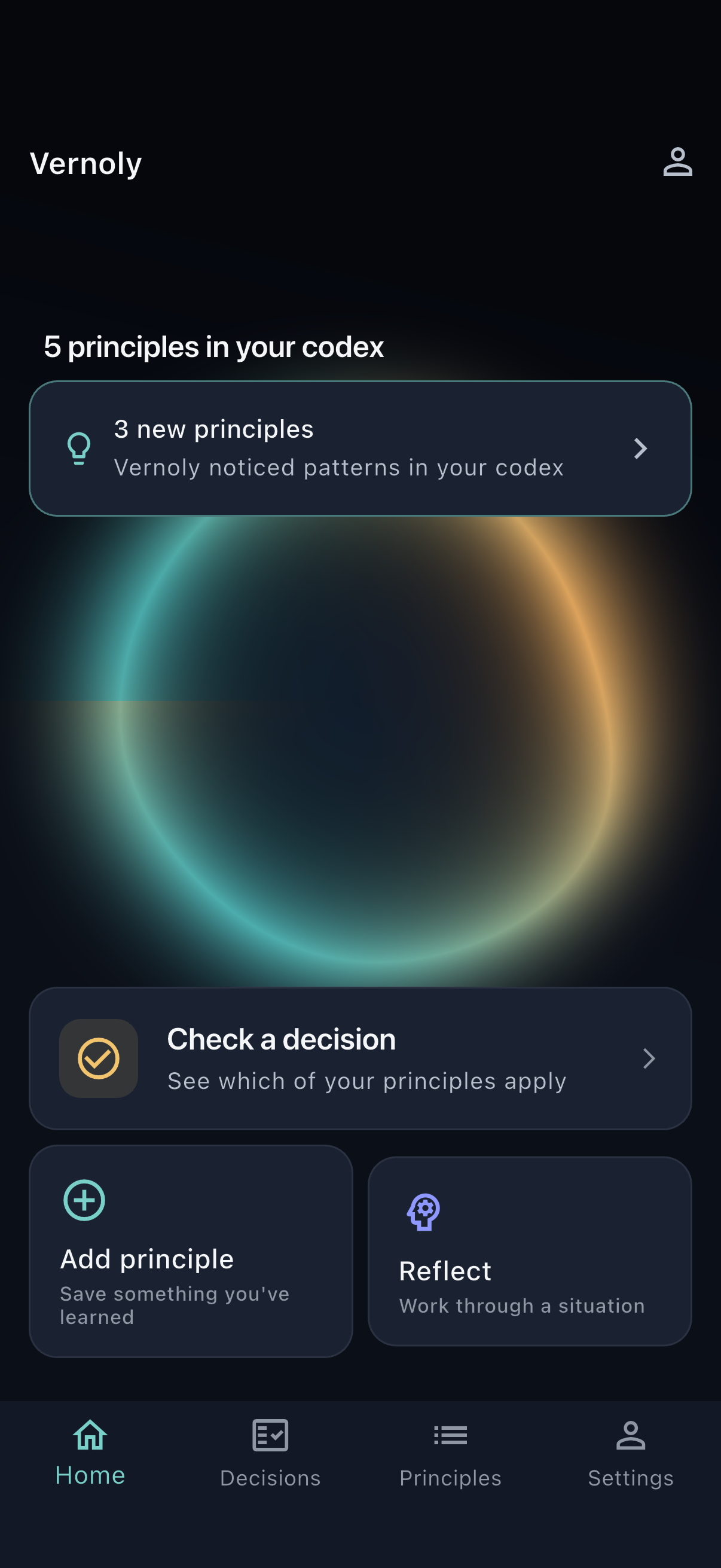
Vernoly turns your experience into a personal codex — and checks your next decision against it. Now on iOS and Android.